 Add to Chrome
 Add to Firefox
 Add to Edge
AMix-2: Establishing Protein as a Native Modality in Large Language Models
May 29, 2026
We present AMix-2, a protein-text foundation model that establishes protein as a native modality in large language models (LLMs), unifying protein understanding and sequence design within a single foundation model. AMix-2 is built upon two key ideas: (1) a unified protein-text formulation that embeds natural language and protein sequence in a shared token space, enabling one model to perform biological reasoning and conditional design instead of separate downstream task-specialized models; and (2) a block-wise diffusion language modeling backbone that combines causal generation across blocks with bidirectional context and iterative refinement within blocks. This scheme better matches the intrinsic nature of proteins than a strict left-to-right factorization. To evaluate protein foundation models under realistic generalization settings, we further introduce ProteinArena, a comprehensive benchmark with time-aware and homology-aware protocols across various understanding and design tasks, and with baselines covering classical bioinformatics tools, protein-specialized models and LLMs. On ProteinArena, AMix-2 outperforms frontier LLMs and demonstrates competitive performance to task-specific protein models. Controlled experiments further show that the diffusion-based paradigm generally surpasses its autoregressive counterpart, highlighting the advantage of flexible generation order for protein sequences. We release both AMix-2 and ProteinArena to facilitate open research in protein foundation models.

IAT: Instance-As-Token Compression for Historical User Sequence Modeling in Industrial Recommender Systems
Apr 10, 2026Although sophisticated sequence modeling paradigms have achieved remarkable success in recommender systems, the information capacity of hand-crafted sequential features constrains the performance upper bound. To better enhance user experience by encoding historical interaction patterns, this paper presents a novel two-stage sequence modeling framework termed Instance-As-Token (IAT). The first stage of IAT compresses all features of each historical interaction instance into a unified instance embedding, which encodes the interaction characteristics in a compact yet informative token. Both temporal-order and user-order compression schemes are proposed, with the latter better aligning with the demands of downstream sequence modeling. The second stage involves the downstream task fetching fixed-length compressed instance tokens via timestamps and adopting standard sequence modeling approaches to learn long-range preferences patterns. Extensive experiments demonstrate that IAT significantly outperforms state-of-the-art methods and exhibits superior in-domain and cross-domain transferability. IAT has been successfully deployed in real-world industrial recommender systems, including e-commerce advertising, shopping mall marketing, and live-streaming e-commerce, delivering substantial improvements in key business metrics.
Explainable Synthetic Image Detection through Diffusion Timestep Ensembling
Mar 08, 2025Recent advances in diffusion models have enabled the creation of deceptively real images, posing significant security risks when misused. In this study, we reveal that natural and synthetic images exhibit distinct differences in the high-frequency domains of their Fourier power spectra after undergoing iterative noise perturbations through an inverse multi-step denoising process, suggesting that such noise can provide additional discriminative information for identifying synthetic images. Based on this observation, we propose a novel detection method that amplifies these differences by progressively adding noise to the original images across multiple timesteps, and train an ensemble of classifiers on these noised images. To enhance human comprehension, we introduce an explanation generation and refinement module to identify flaws located in AI-generated images. Additionally, we construct two new datasets, GenHard and GenExplain, derived from the GenImage benchmark, providing detection samples of greater difficulty and high-quality rationales for fake images. Extensive experiments show that our method achieves state-of-the-art performance with 98.91% and 95.89% detection accuracy on regular and harder samples, increasing a minimal of 2.51% and 3.46% compared to baselines. Furthermore, our method also generalizes effectively to images generated by other diffusion models. Our code and datasets will be made publicly available.
The Challenge of Identifying the Origin of Black-Box Large Language Models
Mar 06, 2025
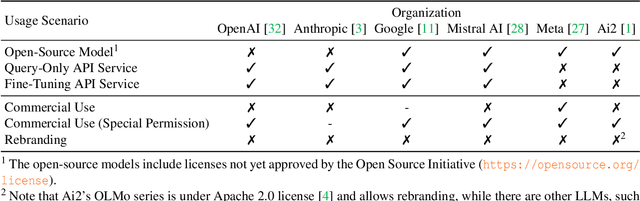


The tremendous commercial potential of large language models (LLMs) has heightened concerns about their unauthorized use. Third parties can customize LLMs through fine-tuning and offer only black-box API access, effectively concealing unauthorized usage and complicating external auditing processes. This practice not only exacerbates unfair competition, but also violates licensing agreements. In response, identifying the origin of black-box LLMs is an intrinsic solution to this issue. In this paper, we first reveal the limitations of state-of-the-art passive and proactive identification methods with experiments on 30 LLMs and two real-world black-box APIs. Then, we propose the proactive technique, PlugAE, which optimizes adversarial token embeddings in a continuous space and proactively plugs them into the LLM for tracing and identification. The experiments show that PlugAE can achieve substantial improvement in identifying fine-tuned derivatives. We further advocate for legal frameworks and regulations to better address the challenges posed by the unauthorized use of LLMs.
Synthetic Artifact Auditing: Tracing LLM-Generated Synthetic Data Usage in Downstream Applications
Feb 02, 2025Large language models (LLMs) have facilitated the generation of high-quality, cost-effective synthetic data for developing downstream models and conducting statistical analyses in various domains. However, the increased reliance on synthetic data may pose potential negative impacts. Numerous studies have demonstrated that LLM-generated synthetic data can perpetuate and even amplify societal biases and stereotypes, and produce erroneous outputs known as ``hallucinations'' that deviate from factual knowledge. In this paper, we aim to audit artifacts, such as classifiers, generators, or statistical plots, to identify those trained on or derived from synthetic data and raise user awareness, thereby reducing unexpected consequences and risks in downstream applications. To this end, we take the first step to introduce synthetic artifact auditing to assess whether a given artifact is derived from LLM-generated synthetic data. We then propose an auditing framework with three methods including metric-based auditing, tuning-based auditing, and classification-based auditing. These methods operate without requiring the artifact owner to disclose proprietary training details. We evaluate our auditing framework on three text classification tasks, two text summarization tasks, and two data visualization tasks across three training scenarios. Our evaluation demonstrates the effectiveness of all proposed auditing methods across all these tasks. For instance, black-box metric-based auditing can achieve an average accuracy of $0.868 \pm 0.071$ for auditing classifiers and $0.880 \pm 0.052$ for auditing generators using only 200 random queries across three scenarios. We hope our research will enhance model transparency and regulatory compliance, ensuring the ethical and responsible use of synthetic data.
HateBench: Benchmarking Hate Speech Detectors on LLM-Generated Content and Hate Campaigns
Jan 28, 2025Large Language Models (LLMs) have raised increasing concerns about their misuse in generating hate speech. Among all the efforts to address this issue, hate speech detectors play a crucial role. However, the effectiveness of different detectors against LLM-generated hate speech remains largely unknown. In this paper, we propose HateBench, a framework for benchmarking hate speech detectors on LLM-generated hate speech. We first construct a hate speech dataset of 7,838 samples generated by six widely-used LLMs covering 34 identity groups, with meticulous annotations by three labelers. We then assess the effectiveness of eight representative hate speech detectors on the LLM-generated dataset. Our results show that while detectors are generally effective in identifying LLM-generated hate speech, their performance degrades with newer versions of LLMs. We also reveal the potential of LLM-driven hate campaigns, a new threat that LLMs bring to the field of hate speech detection. By leveraging advanced techniques like adversarial attacks and model stealing attacks, the adversary can intentionally evade the detector and automate hate campaigns online. The most potent adversarial attack achieves an attack success rate of 0.966, and its attack efficiency can be further improved by $13-21\times$ through model stealing attacks with acceptable attack performance. We hope our study can serve as a call to action for the research community and platform moderators to fortify defenses against these emerging threats.
Image-Perfect Imperfections: Safety, Bias, and Authenticity in the Shadow of Text-To-Image Model Evolution
Aug 30, 2024
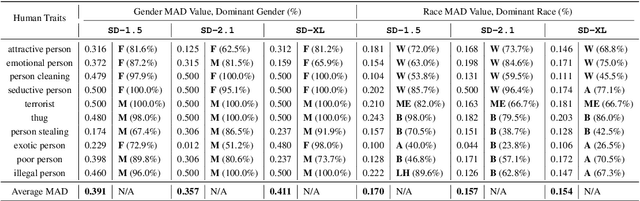

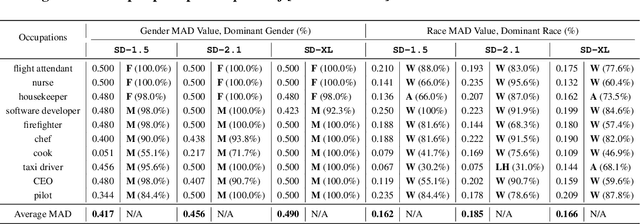
Text-to-image models, such as Stable Diffusion (SD), undergo iterative updates to improve image quality and address concerns such as safety. Improvements in image quality are straightforward to assess. However, how model updates resolve existing concerns and whether they raise new questions remain unexplored. This study takes an initial step in investigating the evolution of text-to-image models from the perspectives of safety, bias, and authenticity. Our findings, centered on Stable Diffusion, indicate that model updates paint a mixed picture. While updates progressively reduce the generation of unsafe images, the bias issue, particularly in gender, intensifies. We also find that negative stereotypes either persist within the same Non-White race group or shift towards other Non-White race groups through SD updates, yet with minimal association of these traits with the White race group. Additionally, our evaluation reveals a new concern stemming from SD updates: State-of-the-art fake image detectors, initially trained for earlier SD versions, struggle to identify fake images generated by updated versions. We show that fine-tuning these detectors on fake images generated by updated versions achieves at least 96.6\% accuracy across various SD versions, addressing this issue. Our insights highlight the importance of continued efforts to mitigate biases and vulnerabilities in evolving text-to-image models.
Towards Few-Shot Learning in the Open World: A Review and Beyond
Aug 19, 2024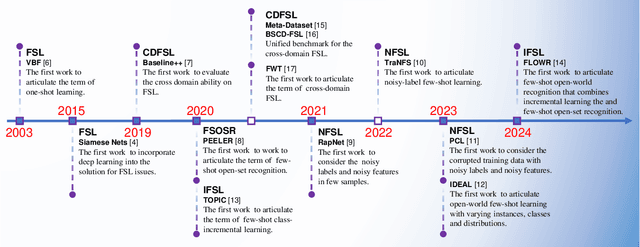
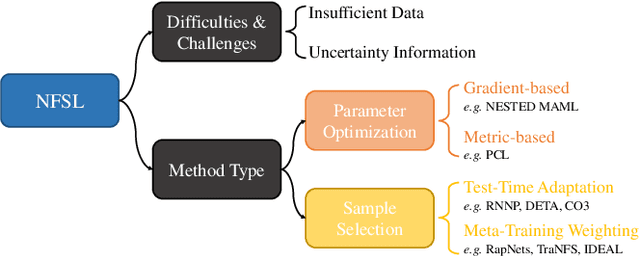
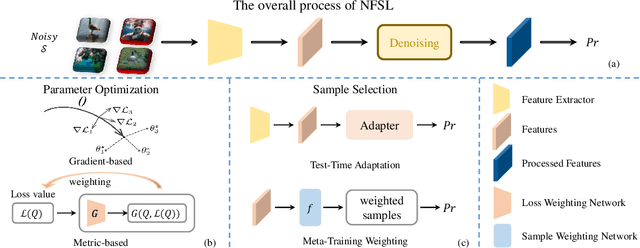
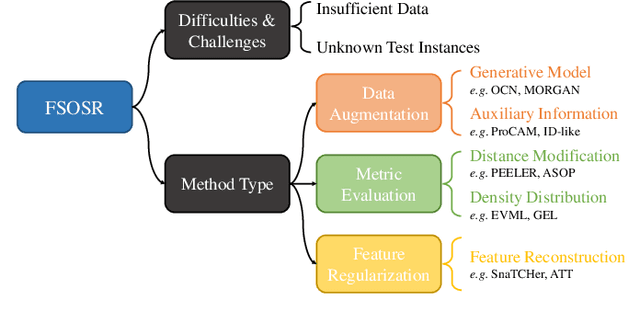
Human intelligence is characterized by our ability to absorb and apply knowledge from the world around us, especially in rapidly acquiring new concepts from minimal examples, underpinned by prior knowledge. Few-shot learning (FSL) aims to mimic this capacity by enabling significant generalizations and transferability. However, traditional FSL frameworks often rely on assumptions of clean, complete, and static data, conditions that are seldom met in real-world environments. Such assumptions falter in the inherently uncertain, incomplete, and dynamic contexts of the open world. This paper presents a comprehensive review of recent advancements designed to adapt FSL for use in open-world settings. We categorize existing methods into three distinct types of open-world few-shot learning: those involving varying instances, varying classes, and varying distributions. Each category is discussed in terms of its specific challenges and methods, as well as its strengths and weaknesses. We standardize experimental settings and metric benchmarks across scenarios, and provide a comparative analysis of the performance of various methods. In conclusion, we outline potential future research directions for this evolving field. It is our hope that this review will catalyze further development of effective solutions to these complex challenges, thereby advancing the field of artificial intelligence.
Searching for Best Practices in Retrieval-Augmented Generation
Jul 01, 2024


Retrieval-augmented generation (RAG) techniques have proven to be effective in integrating up-to-date information, mitigating hallucinations, and enhancing response quality, particularly in specialized domains. While many RAG approaches have been proposed to enhance large language models through query-dependent retrievals, these approaches still suffer from their complex implementation and prolonged response times. Typically, a RAG workflow involves multiple processing steps, each of which can be executed in various ways. Here, we investigate existing RAG approaches and their potential combinations to identify optimal RAG practices. Through extensive experiments, we suggest several strategies for deploying RAG that balance both performance and efficiency. Moreover, we demonstrate that multimodal retrieval techniques can significantly enhance question-answering capabilities about visual inputs and accelerate the generation of multimodal content using a "retrieval as generation" strategy.
Towards Biologically Plausible Computing: A Comprehensive Comparison
Jun 23, 2024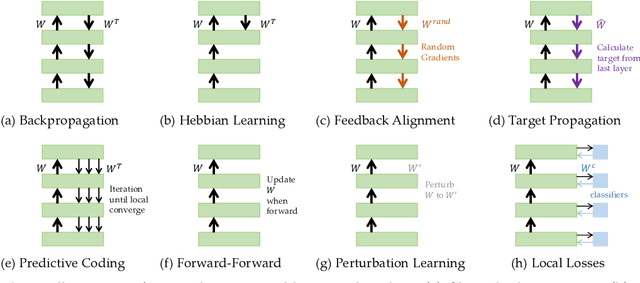

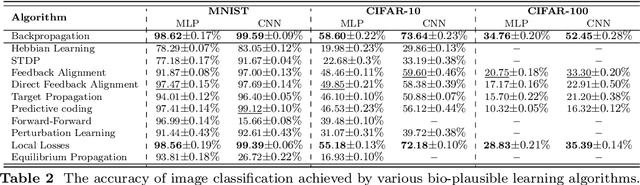

Backpropagation is a cornerstone algorithm in training neural networks for supervised learning, which uses a gradient descent method to update network weights by minimizing the discrepancy between actual and desired outputs. Despite its pivotal role in propelling deep learning advancements, the biological plausibility of backpropagation is questioned due to its requirements for weight symmetry, global error computation, and dual-phase training. To address this long-standing challenge, many studies have endeavored to devise biologically plausible training algorithms. However, a fully biologically plausible algorithm for training multilayer neural networks remains elusive, and interpretations of biological plausibility vary among researchers. In this study, we establish criteria for biological plausibility that a desirable learning algorithm should meet. Using these criteria, we evaluate a range of existing algorithms considered to be biologically plausible, including Hebbian learning, spike-timing-dependent plasticity, feedback alignment, target propagation, predictive coding, forward-forward algorithm, perturbation learning, local losses, and energy-based learning. Additionally, we empirically evaluate these algorithms across diverse network architectures and datasets. We compare the feature representations learned by these algorithms with brain activity recorded by non-invasive devices under identical stimuli, aiming to identify which algorithm can most accurately replicate brain activity patterns. We are hopeful that this study could inspire the development of new biologically plausible algorithms for training multilayer networks, thereby fostering progress in both the fields of neuroscience and machine learning.